New Products & Services
May 2026
Source: Binmaster
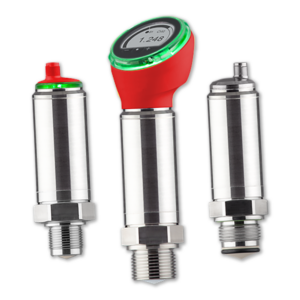
At just 6 in. length and 1.5 in. diameter, CNCR-400 compact non-contact radar level sensor are ideal for small processing vessels, including bins, tanks, hoppers and mixers with agitators. 80-GHz radar technology provides accuracy within 5 mm — even in turbulence, condensation, and buildup — ensuring precision and performance throughout sanitary processes.The CNCR-400 radar series are offered in three different models. Each hygienic sensor measures bulk solids and liquids within ranges up to 49 ft. (15 m):
- Digital Display (DD): Features a digital readout on the sensor face, plus a light ring with programmable colors for visual alerts
- Light Ring Indicator (LRI): Includes a light ring with ability to program colors to alert to critical high or low inventory conditions
- Stainless-Steel Only (SS): Ideal for vessels where local alerts or visual cues are not a requirement; a cost-effective option for continuous process monitoring
Compatibility with cloud-based inventory management software differentiates the CNCR-400 radars from other compact radar sensors. Users can view bulk material levels in real-time, from anywhere, on a phone, tablet or PC. From one site to multi-national operations, operators can view inventory for every bin and plant location from one login and easy-to-use interface. CNCR-400 sensors include 4-20 mA, NPN/PNP, and IO-Link outputs. Setup and configuration are simple using a Bluetooth application on a cell phone. Radars are rated IP66/67/69 for long-term durability, offer .75” and 1” NPT connection options. The compact level sensors include standard c-UL-US ordinary location approvals, plus FDA, 3A, and EHEDG worldwide hygienic approvals. — BinMaster Inc., Lincoln, Neb.
Source: Coperion GmbH
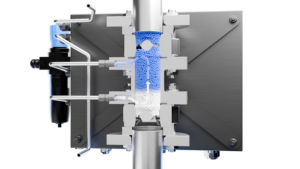
DewTector® is a new moisture-measuring device designed to provide reliable, automated online measurements of surface moisture content in bulk materials, particularly plastic pellets. The patent-pending device offers an economical, simple and reliable method to help plastic manufacturers and recyclers monitor moisture levels more efficiently. It addresses a critical challenge faced by processors in maintaining both product quality and maintaining compliance with industry standards. The DewTector introduces a partial flow of bulk solids into a pressure-tight product chamber. The system determines the moisture content by analyzing the moisture released into the airflow. As the air absorbs moisture, it is analyzed by a hygrometer that measures only water content. This targeted detection ensures reliable results unaffected by other substances or changes in material composition. The system neither requires extensive calibration, nor the use of chemicals for different materials or recipes, making it easy to operate and maintain. The system achieves an accuracy of +5% to −15% across moisture levels ranging from several thousand ppm to a few hundred ppm, with up to ten measurements per hour. Traditionally, moisture measurement has been labor-intensive and prone to inaccuracies, often relying on sporadic manual assessments of relative humidity in bags and containers. Existing automated methods, such as capacitive and microwave resonance techniques are typically complex, expensive and require extensive calibration for different formulations, making them impractical for many users. — Coperion GmbH, Weingarten, Germany
Source: Toray
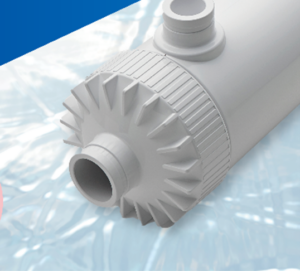
The F-HFUG Series ultrafiltration (UF) membrane module is designed for wastewater reuse, helping to improve lower-biofouling performance of reverse osmosis (RO) membranes and stabilize long-term operations. Proprietary micropore-control technology results in a nominal pore size of just 0.005 micrometers, among smallest in the industry, according to the company's research. The new UF membrane slashes the permeate volume of biopolymers to around one-third of that of its conventional counterparts. Biopolymers are normally hard to remove. Pilot tests at a wastewater-treatment plant demonstrated that the UF membrane suppresses biofouling of downstream RO membranes while maintaining UF permeate flow. The decrease in RO water production attributable to biopolymers is around one-third that of regular membranes. This advantage should reduce chemical cleaning frequency and RO operational issues, helping cut overall wastewater reuse operating costs while lowering water production expenses. — Toray Industries, Inc., Tokyo
Source: Cleanova
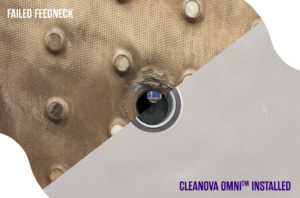
Cleanova OMNI is a patent-pending feed-interface system engineered to address one of the most critical and often overlooked sources of inefficiency in filter press operations: the point where slurry enters the press. Designed for universal compatibility across a wide range of filter press configurations, plate designs, and sizes, OMNI establishes a more durable, consistent, and high-performing foundation for filtration — enabling operators to improve reliability without requiring major equipment changes. In many filter press operations, performance challenges such as premature cloth failure, leakage, and inconsistent filtration results can be traced back to the feed interface; where high-velocity slurry, abrasion and sealing limitations place significant stress on the system. OMNI re-engineers the critical connection point at the feed interface to help make operation more predictable and controlled. By addressing performance at the source, OMNI improves filtration stability, extends cloth life and reduces unplanned downtime in demanding operating environments. Unlike conventional feed interface designs that are often limited to specific OEM equipment, OMNI has been developed as a universally adaptable solution. The system can be deployed across a broad range of plate sizes and is compatible with sidebar, overhead beam and quad press configurations This universal approach allows operators to standardize performance across assets, reduce variability, and simplify maintenance practices without requiring major modifications to existing equipment. OMNI enables the use of single-panel filter cloths, eliminating the need to pull cloths through the feed opening during installation. This design allows cloth replacement without removing filter plates, significantly reducing maintenance time, labor requirements, and operational disruption — particularly in high-throughput environments where uptime is critical. — Cleanova, Newbury, U.K.
Source: Miura America
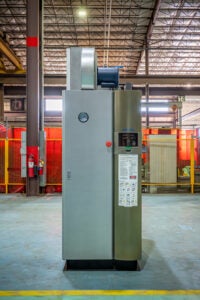
The LX-50 steam boiler delivers reliable, precise steam for pharmaceutical, biotech, and life sciences manufacturing environments. The LX-50 provides the performance and efficiency that facilities need to support cGMP-compliant utilities, validated clean steam generation and critical process heating while maintaining a low environmental footprint. The LX-50 is a standard-pressure boiler that produces approximately 1,730 pounds of steam per hour, giving facilities a compact yet capable option for process loads that demand consistent, high-quality steam. With a once-through, low-water-content watertube design, rapid startup in minutes, and an integrated economizer, the LX-50 delivers on-demand steam with strong fuel efficiency and reduced standby losses. Its compact footprint helps pharmaceutical plants maximize floor space and maintain high uptime in controlled environments. Engineered for low NOx emissions of 20 ppm on natural gas and 25 ppm on propane, and equipped with this company's BL Controller and advanced monitoring capabilities, the LX-50 supports both environmental goals and day-to-day operational reliability. Its modular scalability and precise load control help maintain steam consistency across production equipment, clean utilities, and sterilization lines, making it a strong fit for facilities prioritizing energy optimization and process stability. The LX-50 can be deployed in multi-boiler configurations that scale with production needs and maintain redundancy during service or validation events. This approach enables pharmaceutical manufacturers to sustain steam delivery without interruption, essential for batch integrity, autoclave operations, and continuous processing. — Miura America, Rockmart, Ga.
Source: Clariant
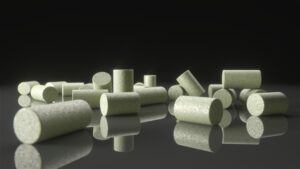
CATOFIN 1000 is the latest generation of propane dehydrogenation (PDH) catalyst, which builds upon the commercially proven CATOFIN 310 Series by delivering improvement in both selectivity and productivity, extended lifetime, and up to 20% lower tar precursors, resulting in significantly reduced fouling. This combination of performance enhancements provides an exceptional value proposition for customers seeking to maximize operational efficiency and returns. CATOFIN is a catalyst technology known for producing olefins, such as propylene, isobutylene and butylene/butadiene. The CATOFIN process combines tailor-made catalysts and Heat Generating Material (HGM) with Lummus' advanced process. The new CATOFIN 1000 catalyst represents the latest evolution in this proven technology platform, offering PDH operators enhanced performance that translates directly to improved plant economics and operational reliability. The up to 20% reduction in tar precursors is particularly significant, as it minimizes fouling-related downtime and maintenance requirements, allowing plants to operate more efficiently over extended periods. — Clariant AG, Muttenz, Switzerland
Source: Herma
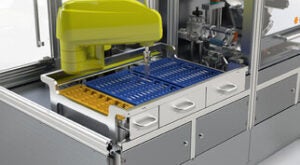
The new 152E HC wrap-around labeling system (photo) is well-suited for pharmaceutical contract packers. It handles a wide range of product formats while requiring only a minimal number of changeable parts. Many pharmaceutical requirements are already implemented as standard, including audit trail and batch reporting capabilities, laser coding, camera inspection, and reject handling via a dedicated conveyor. This is made possible by the standardized design based on this company’s new CleanDesign concept, which also enables shorter delivery times. The 152E HC achieves speeds of up to 200 products per minute while fully meeting pharmaceutical labeling requirements. Thanks to its compact footprint and ease of operation, it integrates seamlessly into existing production environments. — HERMA GmbH, Filderstadt, Germany
www.herma.com
This pressure transmitter works without a PLC
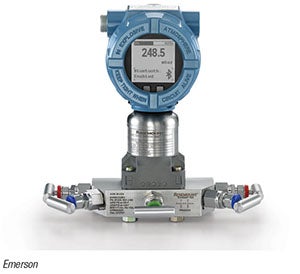 The 4051S pressure transmitter (photo) provides local real-time control, eliminating the need for a separate device, such as a programmable logic controller. This functionality is provided by two relay switches, each of which can be configured to provide on/off control of pumps, motors and other equipment. These switches can also provide alerts based on pressure, flow, totalized flow, level, volume or module temperature. The 4051S is engineered to withstand the harshest process environments, with a 20-year warranty and 20-year stability specification. The response time of 40 ms allows the 4051S to be used in the most demanding applications. The 800:1 turndown ratio reduces the number of unique models needed to be kept in stock. The instrument provides advanced diagnostics, with loop integrity continuously monitoring the electrical loop to detect potential failures. It can also detect plugged impulse lines and cavitation. The graphical, backlit display is larger than previous models, making it easier to read and allowing more descriptive warning messages. — Emerson, St. Louis, Mo.
An ideal pressure scanner for areas where space is limited
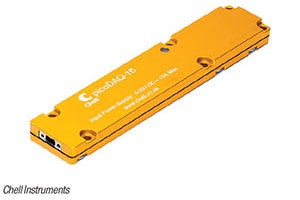 The picoDAQ (photo) is this company’s smallest digital pressure scanner, built to fit into even the most confined testing environments. Measuring 83.4 × 14.8 × 9.6 mm, the picoDAO is ideal for high-accuracy pressure testing in applications where space is limited but precision remains critical, the company says. Despite its ultra-compact size, the picoDAQ retains its measurement capabilities, delivering up to 0.03% FS accuracy output. As a fully configurable smart pressure scanner, the new device can output pressure data in engineering units over Ethernet and CAN, using both CAN-FD and ‘classic’ CAN. The picoDAQ makes use of 17 absolute transducers, which are thermally compensated and conditioned to provide 16 absolute or differential measurements relative to the one reference port. — Chell Instruments, North Walsham, U.K.
These pressure transmitters offer accuracy and ease of use
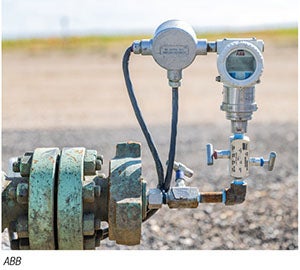 The P-300 pressure transmitter series (photo) ensures high accuracy and ease of use over a broad range of applications in the petrochemical, chemical, power and pulp and paper sectors. The P-300 measures pressure from 0.05 kPa (0.2 in H2O) in differential-pressure applications up to 105 MPa (15,000 psi) and on high-gage-pressure applications, with 0.055% accuracy levels. The P-300 series features a high-contrast backlit display for easy readability in all light conditions. With QR-code-enabled Digital Advanced Diagnostics, users get instant access to product documentation. The P-300 series also meets the latest hazardous-area requirements. — ABB Group, Zurich, Switzerland
Pressure transmitters designed for functional safety
The SITRANS P320 and P420 are pressure transmitters developed for applications that require functional safety. A key characteristic of both devices is the remote safety-handling function, which enables the digital transmission of all safety-relevant functions from the control room, without requiring onsite access to the device. This allows safety integrity level (SIL) commissioning and validation to be carried out centrally, reducing the time and personnel effort associated with onsite handling. Both models support a wide measuring range, from 20 mbar to 700 bars and feature automatic zero-point calibration and guided commissioning procedures. The proof-test interval extends to up to 15 years. Diaphragm materials include stainless steel, Hastelloy, tantalum, Monel, and gold, allowing operation across a wide temperature range from –40 to 100°C. The SITRANS P420 also includes a “Ready for Digitalization” function, which enables up to 1,500 measurement values to be stored directly within the transmitter via trend recording, supporting data availability at the device level without relying on external storage systems. — Siemens AG, Munich, Germany
A submersible pressure sensor for hazardous areas
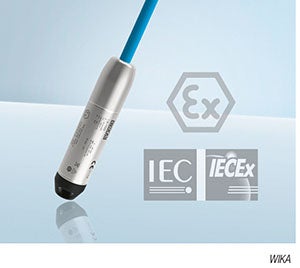 The LS-1000 submersible pressure sensor (photo) is now certified in accordance with the European ATEX and international IEC-Ex directives. The sensor continuously measures the level of liquid media in industrial environments. Thanks to the new approvals, companies can now also use it in hazardous areas of ATEX zone 0 and 1, as well as IEC-Ex zones 0, 1 and 2. This applies to applications in the process industries, wastewater and environmental technology and power generation. Typical applications include wastewater lifting stations, pumping stations and oil and fuel tanks. The LS-1000 measures levels hydrostatically from 1 to 10 m (3.28 to 32.81 ft). Optimal long-term stability of 0.2% ensures precise measured data and minimal signal drift. Thanks to its robust design, the stainless-steel submersible pressure sensor is permanently sealed in accordance with ingress protection IP68. A specially developed cable provides effective strain relief, and potting of the cable inlet provides additional protection. Each individual device undergoes a helium leak test during the final inspection. The submersible pressure sensor is maintenance-free, and can be operated with a 5-V battery. — WIKA Alexander Wiegand SE & Co. KG, Klingenberg, Germany
These pressure-relief devices simplify direct-mounting
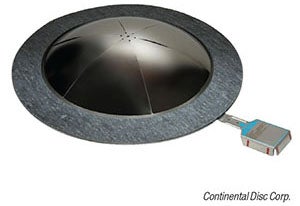 The CDC-CM™ and CDCV-DM™ composite rupture discs (photo) are advanced, holder-less differential pressure-relief devices are engineered to protect pressurized systems, equipment and vessels in critical applications in chemical processing, petrochemicals, oil-and-gas and energy production industries from potentially damaging overpressure conditions. Designed to provide instantaneous, full-opening pressure relief in both liquid and gas-vapor environments, the CDC-DM and CDCV-DM rupture discs provide reliability, corrosion resistance and high performance across a broad range of operating conditions. The new designs incorporate CDC’s proven composite rupture-disc technology with a simplified direct-mount configuration, reducing installation time while maintaining high safety standards. CDC-DM and CDCV-DM direct-mount rupture discs feature a preformed metallic top section with a unique seven-hole apex pattern that ensures non-fragmenting performance when paired with fluoropolymer seals. This construction allows for the use of more durable materials while still achieving an 80% operating-to-burst pressure ratio, one of the highest available in composite discs. Sizes available are 14–36 in. — Continental Disc Corp., Liberty, Mo.